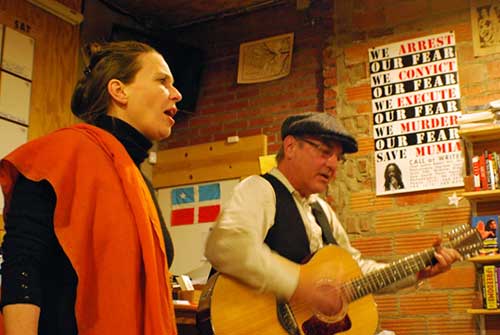
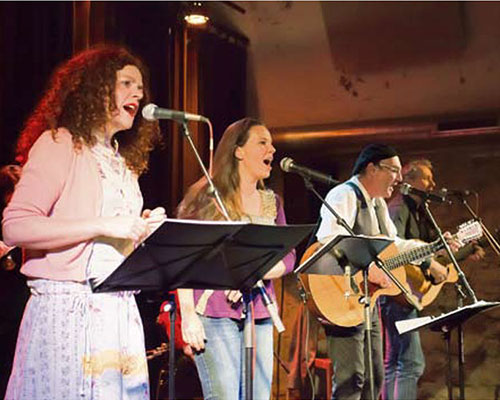
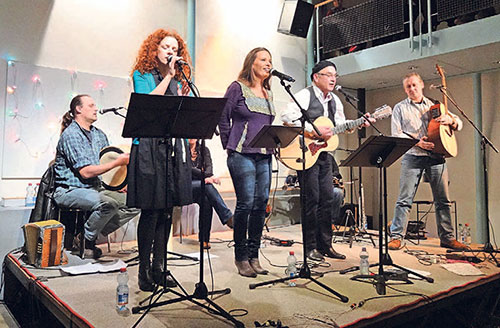
Mat and Yvonne US Tour dates April – May 2013 April 16 April 17 April 18 April 20 April 25 April 26 April 27 April 28 May 2 May 3 May 7 May 10 May 12 contact me directly for all details: info@matcallahan.com
The biggest news at the moment is that Yvonne and I are preparing for a month in the States. We have performances in New York city, Boston and Hartford on the East Coast, San Francisco, Oakland, Santa Rosa and Sacramento on the West Coast. I will post a detailed itinerary in the next week when all of the dates are finalized but the arrival of Spring reminded me that I needed to announce our imminent departure: We leave for New York on April 14 and we return from San Francisco on May 14. Meanwhile, I just returned from Göttingen Germany where I attended a conference called "Music in Detention". From punishment to rehabilitation, torture to therapy, the conference discussed diverse ways the State has employed music in the context of detention, whether those detained were common criminals or political prisoners. But, the overriding theme and the focus of the great majority of papers was the use of music as torture-especially by the Nazis, the fascist juntas in Spain, Portugal and Greece, and most recently by the US government at Guantanamo, Abu Graib and other prisons. The evidence presented was not particularly surprising but it was deeply disturbing, nonetheless. Torture by any method is barbaric but using music to inflict it is a monstrous violation of what makes humans human-or, at least some of us think so. It is nonetheless impossible to deny that the whole subject is fraught with contradictions; the confrontation between cherished ideals, be they aesthetic or political, and historical facts. Especially thought provoking was the presentation given by Professor Suzanne Cusick of New York University. Her own research on the subject began with an exploratory piece published in 2006. Subsequently, Professor Cusick has done exemplary work interviewing victims (former inmates from Guantanamo and other sites) as well as gathering testimony from US soldiers and representatives of government. While she is by no means the only one interested, Professor Cusick is one of very few academics who take it seriously enough to devote time and energy-at some professional risk-in getting to the root of the matter. You can read her original paper here: I will write a report on the conference along with my own views on this subject at a later date. Here, though, I must say that I was at once pleased to attend such a gathering of devoted scholars and troubled to discover how little has been done-either theoretically or practically about a subject that should be the concern of every musician, music lover and political activist. To be blunt, I get the sense that this is now just "yesterday's news" and judging by the internet exchanges Professor Cusick has patiently gathered, it's actually something of a running gag-at least in the blogosphere. It may be that we have all become so desensitized that our ability to distinguish the monstrous from the mundane has been compromised. It may be that other problems seem so much greater in significance and urgency that music as torture can only be viewed as one more in a litany of woes to be regretted but forgotten. Yet, there persists the uneasy feeling that we are entering a realm beyond which all talk of culture, enlightenment, civilization or human emancipation, is not only forbidden, it is nonsense. "Arbeit Macht Frei" (labor makes you free) as the Nazis put it at the gates of Auschwitz. But as we know, the only freedom Auschwitz could offer was death. Likewise with music: if music is torture the remedy is silence. Is this, after all, what the US government is offering anyone critical of its policies: death and silence? After decades spent dissecting the co-optation of music by the Culture Industry or our manipulation by "mass media", everyone is no doubt aware how our judgement, our ability to discern the choices we think we are making, is influenced by shadowy but powerful forces we see without seeing every day. However, such mechanisms operate within the "free market" where the "customer is king" and our desires are instantly gratified with the wave of a magic wand: the credit card! Music as torture is another thing altogether. This is not entertainment, diversion or advertising. This is the State openly admitting that to preserve itself it will destroy the very civilization it claims to be the product and representative of. All the principles of the enlightenment are out the window. All the lofty notions regarding the cultivation of taste, aesthetic sensitivity and ethical conduct are reduced to a blubbering mass of futility. In the end, if music is used as torture it is no longer music. It is noise. But this tactic, turning music into noise, cannot conceal the fear motivating its desperate deployment. The State, in fact, fears music. Music has for centuries been used to mobilize resistance to the State and has often been successful. This is no better exemplified than the use of music in the Civil Rights and Black Liberation struggles in the United States itself. It was also used to similar effect in the struggle against Apartheid — notably by the political prisoners on Robben Island among whom was Nelson Mandela. It is my contention-which I will explore in greater detail at another time-that we are witnessing the breakdown of power structures-including the co-optive and manipulative functions of the Culture Industry and mass media-and, as a consequence, both the potential of mass resistance and the related potential of music as a weapon of liberation are increasing. This is ultimately what is at stake for the State in general and the US government in particular. Please return to this site in a week for more details.
Now for a quick update on several projects. 1. The James Connolly-Songs of Freedom project is entering a new phase. The book and cd are completed and being prepared for printing and manufacture. With the thoughtful assistance of Adi Tosetto of Audioworks in Bern, the mixing and mastering were completed in the first week of February. At the same time the final contents of the book including the cover design were assembled under the guidance of our publisher PM Press. Plans are now underway for concerts in Cork, Dublin, Belfast and Derry from October 2-October 5, 2013. Under discussion are further concerts in Edinburgh and Glasgow to coincide with celebrations in those cities of the life and work of James Connolly. Please contact me for further information. 2. Yvonne Moore, Blue Wisdom Volume 2 is now available. For all those who have heard and were inspired by last year's Blue Wisdom Volume 1, this will be a welcome addition since Volume 2 is more songs performed by the same stellar cast as Volume 1: Hank Schizzoe, guitar, Andi Hug, drums, Andre Pousaz, contrabass and, of course, Yvonne Moore. Once again, the combination of unusual arrangements of old blues played with enthusiastic spontaneity produces a stunning result. Far from the slick, predictable formulas found in most of todays pop offerings, Yvonne Moore's Blue Wisdom Volumes 1 and 2, feature impassioned performance, exactly as it occurred in the studio. We are all very proud of this project. For more information please contact: www.yvonne-moore.ch 3. A visit to the US: Yvonne and I will be traveling to New York City, Boston, Hartford and San Francisco between April 14 and May 14, 2013. We will be performing as a duet in different venues and with different repertoires. In some cases we will be performing our own songs, in others we will be performing selections from the James Connolly Songs of Freedom songbook. In addition, I will be delivering talks on music and politics in various schools. I will post the details on this site in a couple of weeks. Stay tuned!
Mat Callahan interviews Jim Rogers Jim Rogers is a Research Fellow and Associate Lecturer at the School of Communications, Dublin City University, Ireland. Jim’s recent research interests focus on how the music industry has negotiated the transition to digital. It points to many fundamental continuities in terms of how the industry operates, despite the perception of a ‘digital revolution’ bringing transformation to the domain. Jim is the author of The Death and Life of the Music Industry in the Digital Age — a forthcoming book [early 2013] from Bloomsbury Academic. Bloomsbury offers this summary: “This book challenges the conventional wisdom that the internet is ‘killing’ the music industry. While technological innovations (primarily in the form of peer-to-peer file-sharing) have evolved to threaten the economic health of major transnational music companies, this book illustrates how those same companies have themselves formulated highly innovative response strategies to negate the harmful effects of the internet. In short, it illustrates how the radical transformative potential of the internet is being suppressed by legal and organisational innovations. Grounded in a social shaping perspective, the book contends that the internet has not altered pre-existing power relations in the music industry where a small handful of very large corporations have long since established an oligopolistic dominance. Furthermore, the book contends that widespread acceptance of the idea that online piracy is rampant, and music largely ‘free’ actually helps these major music companies in their quest to bolster their power. In doing this, this book serves to deflate much of the transformative hype and digital ‘deliria’ that has accompanied the internet’s evolution as a medium for mass communication.” Our interview covers three broad themes: RFE Episode Seven: music, technology and capitalism, an overview of current developments. An interview with Jim Rogers.
Mat Callahan interviews Josef Brinckmann Josef Brinckmann has 33 years professional experience in the global trade of herbal medicinal products. The most common of these products are teas, pastilles and syrups and Josef has worked with farmers and wild collectors in many parts of the world in bringing their good to market. Josef is also the Senior Consultant for Biodiversity Products with the International Trade Centre (ITC) in Geneva, Switzerland, serving as well as an Advisory Board member of numerous scientific and trade organizations such as the American Botanical Council (ABC) and the American Herbal Pharmacopoeia (AHP). The list is very long and it’s not necessary to present it all to make clear the reason I asked Josef to join us. His rich experience and in-depth knowledge in several overlapping fields, namely botany, agronomy and international trade, make him an invaluable resource regarding some highly contentious issues. This interview explores three broad themes: Health, agriculture and social organization a. how do we define health, what are the purposes to which medicines of any kind are put to use and what differentiates herbal medicine from the synthetic or the traditional from the manufactured. Are these mutually exclusive, interdependent, or something else? b. how do we define growth, progress, efficiency or productivity in relation to plants and animals either raised or wild harvested by farmers, fisher-people, pastoralists or other herding? How is labor in any of these activities related to outcomes? Is there a necessary connection between the work and skill inputs of people and the quality of what is harvested or are industrial methods employing large scale mechanical inputs equivalent in the end product? What is the connection between the knowledge of common farmers, for example, and trained botanists-between “practical” knowledge and science? c. how do we define organic, specifically as it relates to the treatment or life-quality of the producers of nourishment, including medicinal plants. The Demeter standards, for example, name the living conditions of the farmers as a definitive component. Slave labor, debt peonage, serfdom are clearly not acceptable. But what is? Episode 6: Health, agriculture and social organization, an interview with
November is almost over and I'm only now getting to this installment of the monthly news. This is not because nothing happened but because so much did. Time permits only a brief summary but I hope to keep readers up to date on three important projects. First, the final touches are being put on the James Connolly Songs of Freedom book and cd. Most of the printed material has been assembled and is being designed by PM Press in Oakland, California. This book will bring together in one volume three previously published songbooks. One is the original Songs of Freedom, edited by Connolly and published in New York in 1907. The second is the Souvenir Program for a concert held in Dublin in 1919 to commemorate Connolly's birth. The third is the James Connolly Songbook published in 1972 by the Cork Workers Club. The first two have been hidden from public view for a century. I have written a brief Preface to explain how this new book came to be made and its relevance to current affairs. Theo Dorgan, a fine writer and early supporter of this project, has agreed to contribute a biographical essay on Connolly. As for the music on the accompanying cd, it will be finished by year's end. The recordings will be completed by the end of November and the mixes by mid-December. Please return to this site for news. There will be concerts to celebrate the publication of the book/cd in Ireland (at least in Derry and Dublin, perhaps elsewhere in Ireland as well), and very likely the United States. We continue to do fundraising and seek advance orders so any of you who can contribute, please contact me: info@matcallahan.com Mat Callahan Meanwhile, Radio Free Everybody is completing its first half year of podcasting. Two new interviews were conducted in November and more were organized for next year. Upcoming will be a talk with Josef Brinckmann in Sebastopol, California regarding his work in the field of medicinal herbs. This wide ranging discussion takes on the topics of health, agriculture and social organization in a global context. Josef's experience with growers and wild gatherers of diverse species of medicinal plants is an eye-opener. But even more significant is the perspective he brings to relationships between governments, treaty organizations and, inevitably, the giant corporations that dominate pharmaceuticals and agriculture. Next we have a discussion with, Jm Rogers, Research Fellow and Associate Lecturer at the School of Communications, Dublin City University regarding his work on technology and media. Jim's most recent research focuses on how the music industry has negotiated the transition to digital. It points to many fundamental continuities in terms of how the industry operates, despite the perception of a 'digital revolution' bringing transformation to the domain. Jim is the author of 'The Death and Life of the Music Industry in the Digital Age'-a forthcoming book from Bloomsbury Academic. Stay tuned to this site or, visit our dear friends and online host, STIR Magazine, http://stirtoaction.com/ STIR: Volume One "At a moment when alternatives are not obvious to all and most responses to austerity are all too predictable, this crowdfunded collection of articles and interviews from the first years of Stir Magazine looks at how inspiring and innovative groups are taking cooperative and community-led ideas from the margins to the mainstream." Writers as diverse as Simon Critchley, Raj Patel, Nina Power and many others were brought together by editors Jonny Gordon-Farleigh and Abby McFlynn in one beautifully designed volume. Please contact STIR to purchase a copy. STAND & FIGHT
Mat Callahan interviews Dr. Hans-Martin Frey Dr. Hans-Martin Frey is a research associate in the chemistry department at the University of Bern. His work is in general physical chemistry focusing on rotational lasar spectroscopy. Dr. Frey is also a political activist who for many years has been involved in the movement against nuclear power in Switzerland. He first became engaged during the struggle to prevent the construction of the Kaiseraugst nuclear power plant in 1974 (this campaign succeeded in preventing the construction of the plant). More recently, Dr. Frey has been active in the struggle to shut down the Mühleberg nuclear plant near Switzerland’s capital city, Bern-which continues to this day. This combination of scientific training and political engagement provides insights useful to understanding two of the most important issues facing humanity: climate change and nuclear energy. Each of these subjects are controversial but under current circumstances they form a tangled knot of claims and counterclaims fueled by special interests. On this installment of Radio Free Everybody, we’ll be asking basic questions such as “what is science and what separates science from opinion, from self-interest or from politics?” and “What is nuclear energy? is there a scientific consensus about its costs, benefits and dangers?” We also investigate the ways climate change is actually measured and why this has led to a virtually unanimous verdict among scientists that it has a strong anthropogenic component. In other words, greenhouse gases, caused by human activity, are accelerating the heating of the earth and its atmosphere, producing catastrophic consequences for many living creatures including humans. This has led to, on the one hand, claims from the oil and coal industries that there’s nothing to worry about and, on the other hand, from the nuclear power industry that nuclear energy is the only solution! How do we get to the bottom of this and find reliable data for making informed decisions. Episode 5: Science, climate change and nuclear energy, an interview with Dr. Hans-Martin Frey from Bern, Switzerland
Eric Hobsbawm died at the age of 95 On October 1, Eric Hobsbawn died at the age of 95. Hobsbawm was among the world's most important historians. Along with the Annales School in France, especially Fernand Braudel, Hobsbawm was a major figure in revolutionizing historiography. This entailed the wholesale assault on and decisive defeat of the "great man theory" of history which dominated history departments throughout Academia until the 1960's. Replacing it instead with the "history from the bottom up" Hobsbawm demonstrated the usefulness of studying society's "lower orders", the people whom history had previously ignored. This revitalized the study of history and along with Braudel's theory of the longue durée (or history of very long periods of time) changed what we consider important or worthy of examination. Hobsbawm pioneered the study of bandits, working class rebellions, and popular insurgencies, firmly establishing new methods of assessment as well as the reevaluation of causes and effects. His great series, the "Age" books, provide a much needed antidote to those conventional histories devoted to glorifying conquistadors, monarchs and potentates. The Age of Revolution, The Age of Capital and The Age of Empires, not only offer new data and insights in regards to the forces that shaped our present but they deal a stunning blow to the apologists for slavery and imperial conquest, not to mention current defenders of neo-liberalism. His summary of the short 20th Century (1914–1991), The Age of Extremes, is both a conclusion to the "Ages" series and a reckoning with the consequences of what is covered by the three previous books. His last book, published in 2011 was appropriately titled: How to Change the World. For a lifelong communist and internationalist scholar, what could be a more resounding finale! What follows is the review of the book by Terry Eagleton that appeared in the London Review of Books last year. Indomitable Terry Eagleton In 1976, a good many people in the West thought that Marxism had a reasonable case to argue. By 1986, most of them no longer felt that way. What had happened in the meanwhile? Were these people now buried under a pile of toddlers? Had Marxism been unmasked as bogus by some world-shaking new research? Had someone stumbled on a lost manuscript by Marx confessing that it was all a joke? We are speaking, note, about 1986, a few years before the Soviet bloc crumbled. As Eric Hobsbawm points out in this collection of essays, that wasn’t what caused so many erstwhile believers to bin their Guevara posters. Marxism was already in dire straits some years before the Berlin Wall came down. One reason given was that the traditional agent of Marxist revolution, the working class, had been wiped out by changes to the capitalist system – or at least was no longer in a majority. It is true that the industrial proletariat had dwindled, but Marx himself did not think that the working class was confined to this group. In Capital, he ranks commercial workers on the same level as industrial ones. He was also well aware that by far the largest group of wage labourers in his own day was not the industrial working class but domestic servants, most of whom were women. Marx and his disciples didn’t imagine that the working class could go it alone, without forging alliances with other oppressed groups. And though the industrial proletariat would have a leading role, Marx does not seem to have thought that it had to constitute the social majority in order to play it. Even so, something did indeed happen between 1976 and 1986. Racked by a crisis of profits, old style mass production gave way to a smaller scale, versatile, decentralised ‘post-industrial’ culture of consumerism, information technology and the service industries. Outsourcing and globalisation were now the order of the day. But this did not mean that the system had essentially changed, thus encouraging the generation of 1968 to swap Gramsci and Marcuse for Said and Spivak. On the contrary, it was more powerful than ever, with wealth concentrated in even fewer hands and class inequalities growing apace. It was this, ironically, which sparked the leftist rush for the exits. Radical ideas withered as radical change seemed increasingly implausible. The only public figure to denounce capitalism in the past 25 years, Hobsbawm claims, was Pope John Paul II. All the same, another couple of decades later, the fainthearted witnessed a system so exultant and impregnable that it only just managed to keep the cash machines open on the high streets. Eric Hobsbawm, who was born in the year of the Bolshevik revolution, remains broadly committed to the Marxist camp – a fact worth mentioning as it would be easy to read this book without realising it. This is because of its judiciousness, not its shiftiness. Its author has lived through so much of the political turbulence he portrays that it is easy to fantasise that History itself is speaking here, in its wry, all-seeing, dispassionate wisdom. It is hard to think of a critic of Marxism who can address his or her own beliefs with such honesty and equipoise. Hobsbawm, to be sure, is not quite as omniscient as the Hegelian World-Spirit, for all his cosmopolitan range and encyclopedic knowledge. Like many historians he is not at his sharpest in the realm of ideas, and he is wrong to suggest that the disciples of Louis Althusser treated Marx’s Capital as though it were primarily a work of epistemology. Nor would Hegel’s Geist treat feminism, not least Marxist feminism, with such cold-eyed indifference, or consign one of the most fertile currents of modern Marxism – Trotskyism – to a few casual asides. Hobsbawm also thinks that Gramsci is the most original thinker produced by the West since 1917. Perhaps he means the most original Marxist thinker, but even that is dubious. Walter Benjamin is surely a better qualified candidate for that title. Even the most erudite students of Marxism, however, will find themselves learning from these essays. It is, for example, part of the stock-in-trade of historical materialism that Marx broke decisively with the various utopian socialists who surrounded him. (One of them believed that in an ideal world the sea would turn into lemonade. Marx would probably have preferred Riesling.) Hobsbawm, by contrast, insists on Marx’s substantial debt to these thinkers, who ranged from ‘the penetratingly visionary to the psychically unhinged’. He is clear about the fragmentary nature of Marx’s political writings, and rightly insists that the word ‘dictatorship’ in the phrase ‘dictatorship of the proletariat’, used by Marx to describe the Paris Commune, means nothing like what it means today. Revolution was to be seen not simply as a sudden transfer of power but as the prelude to a lengthy, complex, unpredictable period of transition. From the late 1850s onwards, Marx did not consider any such seizure of power either imminent or probable. Much as he cheered on the Paris Commune, he expected little from it. Nor was revolution to be simplemindedly opposed to reform, of which Marx was a persistent champion. As Hobsbawm might have added, there have been some relatively bloodless revolutions and some spectacularly bloody processes of social reform. An absorbing chapter on Engels’s The Condition of the Working Class in England claims it as the first study anywhere to deal with the working class as a whole, not merely with particular sectors or industries. In Hobsbawm’s view, its analysis of the social impact of capitalism is still in many respects unsurpassed. The book does not paint its subject in too lurid a colour: the charge that it depicts all workers as starving or destitute, or living purely at subsistence level, is groundless. Nor is the bourgeoisie presented as a bunch of black-hearted villains. As so often, it takes one to know one: Engels himself was the son of a wealthy German manufacturer who ran a textile mill in Salford, and used his ill-gotten gains to help keep the down-at-heel Marx family afloat. He also enjoyed a spot of fox-hunting, and as a champion of both the proletariat and the colonial Irish maintained a unity of theory and practice by taking a working-class Irish woman as his mistress. Did Marx see the victory of socialism as inevitable? He says so in The Communist Manifesto, though Hobsbawm denies that it is a deterministic document. Yet this is partly because he does not inquire into what kind of inevitability is at stake. Marx sometimes writes as if historical tendencies had the force of natural laws; but it is doubtful even so that this is why he saw socialism as the logical outcome of capitalism. If socialism is historically predestined, why bother with political struggle? It is rather that he expected capitalism to become more exploitative, while the working class grew in strength, numbers and experience; and these men and women, being moderately rational, would then have every reason to rise up against their oppressors. Rather as for Christianity the free actions of human beings are part of God’s preordained plan, so for Marx the tightening contradictions of capitalism will force men and women freely to overthrow it. Conscious human activity will bring revolution about, but the paradox is that this activity is itself in a sense scripted. You cannot, however, speak of what free men and women are bound to do in certain circumstances, since if they are bound to do it they are not free. Capitalism may be teetering on the verge of ruin, but it may not be socialism that replaces it. It may be fascism, or barbarism. Hobsbawm reminds us of a small but significant phrase in The Communist Manifesto which has been well-nigh universally overlooked: capitalism, Marx writes ominously, might end ‘in the common ruin of the contending classes’. It is not out of the question that the only socialism we shall witness is one that we shall be forced into by material circumstance after a nuclear or ecological catastrophe. Like other 19th-century believers in progress, Marx did not foresee the possibility of the human race growing so technologically ingenious that it ends up wiping itself out. This is one of several ways in which socialism is not historically inevitable, and neither is anything else. Nor did Marx live to see how social democracy might buy off revolutionary passion. Few works have sung the praises of the middle classes with such embarrassing zest as The Communist Manifesto. In Marx’s view, they have been by far the most revolutionary force in human history, and without harnessing for its own ends the material and spiritual wealth they have accumulated, socialism will prove bankrupt. This, needless to say, was one of his shrewder prognostications. Socialism in the 20th century turned out to be most necessary where it was least possible: in socially devastated, politically benighted, economically backward regions of the globe where no Marxist thinker before Stalin had ever dreamed that it could take root. Or at least, take root without massive assistance from more well-heeled nations. In such dismal conditions, the socialist project is almost bound to turn into a monstrous parody of itself. All the same, the idea that Marxism leads inevitably to such monstrosities, as Hobsbawm observes, ‘has about as much justification as the thesis that all Christianity must logically and necessarily always lead to papal absolutism, or all Darwinism to the glorification of free capitalist competition’. (He does not consider the possibility of Darwinism leading to a kind of papal absolutism, which some might see as a reasonable description of Richard Dawkins.) Hobsbawm, however, points out that Marx was actually too generous to the bourgeoisie, a fault of which he is not commonly accused. At the time of The Communist Manifesto, their economic achievements were a good deal more modest than he imagined. In a curious garbling of tenses, the Manifesto described not the world capitalism had created in 1848, but the world as it was destined to be transformed by capitalism. What Marx had to say was not exactly true, but it would become true by, say, the year 2000, and it was capitalism that would make it so. Even his comments on the abolition of the family have proved prophetic: about half of the children in advanced Western countries today are born to or brought up by single mothers, and half of all households in large cities consist of single persons. Hobsbawm’s essay on the Manifesto speaks of its ‘dark, laconic eloquence’, and notes that as political rhetoric it has ‘an almost biblical force’. ‘The new reader,’ he writes, ‘can hardly fail to be swept away by the passionate conviction, the concentrated brevity, the intellectual and stylistic force of this astonishing pamphlet.’ The Manifesto initiated a whole genre of such declarations, most of them from avant-garde artists such as the Futurists and the Surrealists, whose outrageous wordplay and scandalous hyperbole turn these broadsides into avant-garde artworks in themselves. The manifesto genre represents a mixture of theory and rhetoric, fact and fiction, the programmatic and the performative, which has never been taken seriously enough as an object of study. Marx, too, was an artist of sorts. It is often forgotten how staggeringly well read he was, and what painstaking labour he invested in the literary style of his works. He was eager, he remarked, to get shot of the ‘economic crap’ of Capital and get down to his big book on Balzac. Marxism is about leisure, not labour. It is a project that should be eagerly supported by all those who dislike having to work. It holds that the most precious activities are those done simply for the hell of it, and that art is in this sense the paradigm of authentic human activity. It also holds that the material resources that would make such a society possible already exist in principle, but are generated in a way that compels the great majority to work as hard as our Neolithic ancestors did. We have thus made astounding progress, and no progress at all. In the 1840s, Hobsbawm argues, it was by no means improbable to conclude that society was on the verge of revolution. What was improbable was the idea that within a handful of decades the politics of capitalist Europe would be transformed by the rise of organised working-class parties and movements. Yet this is what came to pass. It was at this point that commentary on Marx, at least in Britain, began to shift from the cautiously admiring to the near hysterical. In 1885, no less devout a non-revolutionary than Balfour commended Marx’s writings for their intellectual force, and for their economic reasoning in particular. A whole raft of liberal or conservative commentators took his economic ideas with intense seriousness. Once those ideas took the form of a political force, however, a number of ferociously anti-Marxist works began to appear. Their apotheosis was Hugh Trevor-Roper’s stunning revelation that Marx had made no original contribution to the history of ideas. Most of these critics, I take it, would have rejected the Marxist view that human thought is sometimes bent out of shape by the pressure of political interests, a phenomenon commonly known as ideology. Only recently has Marxism been back on the agenda, placed there, ironically enough, by an ailing capitalism. ‘Capitalism in Convulsion’, a Financial Times headline read in 2008. When capitalists begin to speak of capitalism, you know the system is in dire trouble. They have still not dared to do so in the United States. There is much else to admire in How to Change the World. In a suggestive passage on William Morris, the book shows how logical it was for a critique of capitalism based on the arts and crafts to spring up in England, where advanced industrial capitalism posed a deadly threat to artisanal production. A chapter on the 1930s contains a fascinating account of the relations between Marxism and science – it was the only period, Hobsbawm points out, when natural scientists were attracted to Marxism in significant numbers. As the threat of an irrationalist Fascism loomed, it was the ‘Enlightenment’ features of the Marxist creed – its faith in reason, science, progress and social planning – which attracted men like Joseph Needham and J.D. Bernal. During Marxism’s next historical upsurge, in the 1960s and 1970s, this version of historical materialism would be ousted by the more cultural and philosophical tenets of so-called Western Marxism. In fact, science, reason, progress and planning were now more enemies than allies, at war with the new libertarian cults of desire and spontaneity. Hobsbawm shows only qualified sympathy for the 1968ers, which is unsurprising in a long-term member of the Communist Party. Their idealisation of the Cultural Revolution in China, he suggests with some justice, had about as much to do with China as the 18th-century cult of the noble savage had with Tahiti. ‘If one thinker left a major indelible mark on the 20th century,’ Hobsbawm remarks, ‘it was he.’ Seventy years after Marx’s death, for better or for worse, one third of humanity lived under political regimes inspired by his thought. Well over 20 per cent still do. Socialism has been described as the greatest reform movement in human history. Few intellectuals have changed the world in such practical ways. That is usually the preserve of statesmen, scientists and generals, not of philosophers and political theorists. Freud may have changed lives, but hardly governments. ‘The only individually identifiable thinkers who have achieved comparable status,’ Hobsbawm writes, ‘are the founders of the great religions in the past, and with the possible exception of Muhammad none has triumphed on a comparable scale with such rapidity.’ Yet very few, as Hobsbawm points out, would have predicted such celebrity for this poverty-stricken, carbuncle-ridden Jewish exile, a man who once observed that nobody had ever written so much about money and had so little. Most of the pieces collected in this book have been published before, though about two-thirds of them have not appeared in English. Those without Italian can therefore now read a number of important essays by Hobsbawm which first appeared in that language, not least three substantial surveys of the history of Marxism from 1880 to 1983. These alone would make the volume uniquely valuable; but they are flanked by other chapters, on such topics as pre-Marxian socialism, Marx on pre-capitalist formations, Gramsci, Marx and labour, which broaden its scope significantly. How to Change the World is the work of a man who has reached an age at which most of us would be happy to be able to raise ourselves from our armchairs without the aid of three nurses and a hoist, let alone carry out historical research. It will surely not be the last volume we shall be granted by this indomitable spirit.
Mat Callahan interviews Cesare Silvi Cesare Silvi is a mechanical and nuclear engineer who was employed by the Italian government in the mid-1970s to study safety at nuclear power plants. The goal was to design reactors that could withstand any threat be it enemy attack or catastrophes such as those that subsequently occurred at Three Mile Island, Chernobyl and more recently at Fukushima. Years of research led Silvi to the conclusion that there was no practical means of making nuclear energy safe nor could its production be justified economically or scientifically. This led him to a deep inquiry into what he has termed "Sun Science". For the last twenty years Silvi has been active in the International Solar Energy Society from which has emerged an entirely new perspective on solar energy as well as many innovative proposals. Today he chairs Il Gruppo per la storia dell’energia solare (the Group for the history of solar energy, GSES, www.gses.it; info@gses.it) and the Italian National Committee: "The History of Solar Energy", established in 2006 by the Ministry of Heritage and Culture. Episode 4: Energy, engineering and philosophy - Interview with Cesare Silvi from Rome, Italy
James Connolly Songs of Freedom-Dublin meetings September 2012
We agreed on a number of important points. First, October 2013 was chosen as the date of publication. On the one hand this will benefit from the year long celebrations of the Dublin Lockout of 1913 in which Connolly played a crucial role. On the other, it keeps the focus on Connolly as attention will, by October, begin shifting to the commemoration of the Easter Rising in 2016. Second, it was agreed that PM Press would be the publisher and in collaboration with SIPTU, other unions in Ireland, the United States and in other countries, would bring Songs of Freedom to the widest possible audience worldwide. Finally, it was agreed that the remaining funds necessary to finalize production would be sought directly through SIPTU and other unions as well as from supporters of the project from all walks of life. More specifically, a budget was submitted by PM Press that established both the basic costs as well as the lowest possible retail price. The costs are approximately $25,000 for 3000 copies of song book and cd. The retail price will be $14 for book alone, $15 for cd alone and $20 for book and cd together, shrink wrapped. It is hoped that unions will contribute by ordering copies in advance thus guaranteeing the costs are covered and the books and cds made available directly to union members. PM Press will handle distribution through book stores and other outlets to reach the general public. The final point discussed was a proposed concert at Liberty Hall, Dublin, to announce the publication of the song book and cd. It so happened, we had that very morning received an invitation from Joe Mulheron to launch the publication at his club, Sandino's in Derry, so we already had before us two concerts around which to organize a promotional tour. Naturally, this will require more funding and logistical support. It was agreed that we would begin work on this idea immediately but that it would depend to a large extent on our successfully completing the production of the song book and cd. Fortunately, Frank and Padraig were inspired by the music and on that basis consider the concerts an important means of building support for the project as a whole. It was agreed that Liberty Hall would be secured for the event but that we would have to collaborate with others to bring out the public and make the event a success. Later the same day, a listening session was convened at the Dublin Teachers Club. A wonderful group of artists and activists, many with decades of experience in labor and political struggles, came to listen to the music. We played the recording from beginning to end. The audience sat in attentive silence from the first to the last note. Any uncertainty I had was immediately removed by the general enthusiasm of all in attendance. It was a heartwarming vote of confidence for all of us who've worked long and hard to make the songs of James Connolly come to life. A lively discussion followed with numerous concrete suggestions of how to build an audience for the finished product. It was suggested that a documentary be made of how this project was conceived and realized. It was further suggested that a translation be made into spanish and a collaboration be initiated with the Victor Jara Foundation. This is especially relevant because the President of Ireland, Michael Higgins, will be making an official visit to Chile next October and could make use of the Songs of Freedom in his presentation. It was clear that the music inspired everyone to think of ways to bring its message to world. It was especially encouraging that two of Connolly's great grandchildren were present and urged us on. Michelle Connolly in particular said how much she enjoyed the great spirit of the music and that this would certainly appeal to young people. Afterwards, we all went to the bar downstairs and carried on discussion over pints of Guinness. I certainly had the feeling that this small event would galvanize the support needed to not only complete the making of the song book and cd but to give it the greatest public reception when it finally arrives. *(These two separate song books will be accompanied by the front cover and introduction to the version of the James Connolly Songbook published by the Cork Workers Club in 1972. Since the songs in the Cork Workers Club version are taken directly from the 1919 Souvenir program there is no reason to duplicate them here. The reasons to republish the 1907 and 1919 books in their entirety are, first, very few people alive today have ever seen the originals and they are of great historical interest. Secondly, while some songs are duplicated many, especially those written by Connolly himself, are not. Together all three song books tell a fascinating story that follows Connolly's own life and enduring legacy which led to the present effort half a century after the Cork Workers Club book was published.)
Alain Badiou
Let us consult our masters: discreet bankers; media stars; hesitant representatives of major commissions; spokesmen of the ‘international community‘; busy presidents; new philosophers; factory and estate owners; stock market men and boards of directors; chattering opposition politicos; urban and provincial notables; economists of growth; sociologists of citizenship; experts on all sorts of crises; prophets of the ‘clash of civilizations’; heads of the police, justice and ‘penitentiary’ systems; profit assessors; productivity calculators; the prim editorialists of serious newspapers; human resources directors; people who in their own view are of some account; people one would do well not to take for nobodies. What have they got to say about it, all these rulers, all these opinion-formers, all these leaders, all these thimble-rigging tyrants? They all say that the world is changing at a dizzying pace and that, if we are not to risk ruin or death (for them it comes to the same thing), we must adapt to this change or, in the world as it is, be but a mere shadow of ourselves. That we should energetically engage in incessant ‘modernization’ , accepting the inevitable costs without a murmur. Given the harsh competitive world that daily confronts us with challenges, we must climb the steep slopes of productivity, budget reduction, technological innovation, the good health of our banks, and job flexibility. All competition is sportive in its essence. In short, we must form part of the final breakaway alongside the champions of the moment (a German ace, a Thai outsider, a British veteran, a Chinese newcomer, not to mention the ever vigorous Yankee, and so on), and never crawl at the back of the pack. To that end everyone must pedal: modernize, reform, change! What politician on the campaign trail can dispense with proposing reform, change, novelty? The argument between government and opposition always takes the following form : What the others are saying isn’t real change. It’s a thinly resprayed conservatism. I represent real change! You’ve only to look at me to know it. I reform and modernize; new laws rain down every week – bravo! Let’s break with routine ! Out with the old ! So let us change. But change what, in fact? If change is to be permanent, its direction, so it would seem, must be constant. All the measures dictated to us by the economic situation are to be implemented as a matter of urgency. This is so that the rich can continue to get rich while paying fewer taxes; so that the workforce of firms can be reduced with numerous redundancies and extensive restructuring; so that everything which is public can be privatized, and thereby ultimately contribute not to the public good (a particularly ‘anti-economic’ category) , but to the wealth of the rich and the maintenance (costly, alas) of the middle classes, who form the reserve army of the rich; so that schools, hospitals, housing, transport and communications – those five pillars of a satisfactory life for all – can initially be regionalized (that is a step forward), then exposed to competition (that is crucial) , and finally handed over to the market (that is decisive) , in order that the places and resources where and with which the rich and semi-rich are educated, treated, housed and transported cannot be confused with those where the poor and their like struggle to get by; so that workers of foreign origin, who have often lived and worked here for decades, can have their rights reduced to nothing, their children targeted, their statutory papers rescinded, and have to endure the furious campaigns of ‘civilization’ and ‘our values’ against them; so that, in particular, young girls can only go out on the streets with their heads uncovered, and the rest too, mindful as they must be of affirming their ‘secularity’ ; so that the mentally ill can be imprisoned for life; so that the countless social ‘privileges’ on which the lower classes are getting fat can be hunted down; so that bloody military expeditions can be mounted the world over, especially in Africa, to enforce respect for ‘human rights’ – i.e. the rights of the powerful to carve up states, to put in power (through a combination of violent occupation and phantom ‘ elections’) corrupt valets, who will hand over the totality of the country’s resources to the aforesaid powerful for nothing. Those who, for whatever reason, and even if they were serviceable for ‘modernization’ in the past, even If they were obliging valets, are suddenly opposed to the carve-up of their country, to its pillaging by the powerful and the ‘human rights’ that go with it, will be brought before the tribunals of modernization, and hanged if possible. Such is the invariant truth of ‘change’, the actuality of ‘reform’ , the concrete dimension of ‘modernization’. Such, for our masters, is the law of the world. This short book aims to oppose to this view of things a rather different one, which can be summarized here in three points.
It's June 13, mid-way through the month, and I'm only now getting to what's supposed to be posted on the first! A diary of the last two months would explain the delay but it would also fill many pages so I'll confine my remarks to the two most timely matters. These are the continued podcast of Radio Free Everybody from the Stir magazine website and the progress toward completion of the James Connolly-Songs of Freedom project. Interest in the theme of intellectual property is, of course, the main reason event organizers were drawn to Radio Free Everybody's podcast of Professor Story's interview. But it is certainly gratifying to know that people are listening and, even better, are inspired to take the discussion further. The Songs of Freedom project took a major step forward in May and June. Public meetings were held in San Francisco and Santa Rosa which brought forth an outpouring of support. Money was raised to cover the expenses of travel and to aid in completing the recording of the music. Even more important, I was greeted by an enthusiasm beyond all my expectations. Members of the labor movement as well as those who've long been involved with the struggle for Irish self-determination could be counted on to encourage any revival of interest in Connolly's work. But I could not have anticipated the galvanizing effect this man I'd thought forgotten-at least in the US-would have. Perhaps it's just my ignorance but it was nonetheless inspiring to see all these veteran fighters gather together, itself a tribute to Connolly's vision. As a direct result of this public meeting I was invited to present an appeal for support to the executive board of ILWU Local 34. This appeal was greeted with warm interest and I'm hopeful that the union will choose to contribute either by donating funds or, even better, the advance purchase of the completed book and CD.
Q&A with Radio Free Everybody host Mat Callahan How can philosophy be used to advance the struggle for a better world? How can people participate in discussions that cut through both the fog of opinion and the barrier of “expertise”? Radio Free Everybody consists of conversations between the host, Mat Callahan and guests who want to share their specialized knowledge in the arts and sciences. Episode 1. Intellectual Property, Copyright, Patent and the Law with guest Dr. Alan Story, lawyer and teacher at the University of Kent
As readers will have noticed, I missed the deadline for April's news. This is due to several projects I'm involved with, each having its own schedule but overlapping with the others. April 1, I traveled to Ireland to continue work on the James Connolly-Songs of Freedom project and the weeks prior to the trip were taken up with organizing not only that trip but a visit to London that followed immediately. Furthermore, I have for several months been preparing an extended visit to San Francisco, requiring a good deal of planning with friends and associates in that city. Since I'll be in San Francisco for the month of May I decided it would be best to combine April and May in one installment of these monthly reports. Work on the Connolly project went well what with the recording of fiddle, pipes and whistles at Doolittle Recording near Sligo, Ireland. With the able assistance of engineer Urs Lanz, Stefanie Aeschlimann and Joe McHugh provided crucial melodic lines on their respective instruments bringing the recording one big step closer to completion. We will now record the remaining vocal parts to be sung by Shannon Callahan, Shirley Grimes and Yvonne Moore, here in Bern. This will leave only the accordion and perhaps a few additional instrumental parts to be completed in June when I return from San Francisco. There is, however, still a lot of work to be done before the entire project is ready to be brought before the public. For one thing, the book has to be prepared. The contents are of course already in existence since they consist, for the most part, of James Connolly's texts. But since republication will in fact include not only Connolly's original Songs of Freedom, but two other subsequent books containing his lyrics, a new design and layout is required. In addition, arrangements have to be made for getting text and recorded music out to the widest possible audience. Discussions are underway with a growing number of interested individuals and organizations about how best to accomplish this task. Fortunately, there is great interest in James Connolly and the Songs of Freedom project both in Ireland and the United States. This might seem obvious as regards Ireland but it should not be forgotten that Connolly's role in the workers' struggle in the United States was considerable. Connolly spent seven years, between 1903 and 1910, organizing throughout the country. While mainly based in New York, Connolly traveled widely, speaking before gatherings of socialists, trade unionists and other political activists, including a stop in San Francisco. While to a certain extent this resulted from Connolly's sharing the fate of many Irish people who emigrated en masse from their impoverished homeland, it was for his revolutionary views that he became well known. Indeed, positions he took and ideas he articulated were among the most advanced in the world at the time and still contain much wisdom from which we can learn. These include his view of the struggle for national liberation in Ireland as well as the necessity for a revolutionary workers movement directed at the elimination of capitalism. Connolly made a lasting impact not least on the struggles of the dockworkers in San Francisco and the militancy of the ILWU. This legacy will be part of my presentation at a James Connolly event to be held Wednesday, May 2, 2012, 7:30 p.m. at the Eric Quezada Center for Culture and Politics, 518 Valencia Street. The event is co-sponsored by Freedom Archives and Shaping San Francisco. I especially want to thank Claude Marx and Chris Carlsson for making this possible. Meanwhile, after my visit to Ireland, I traveled to London to deliver a talk at Housman's Bookstore. Housman's is a wonderful bookstore reminiscent of City Lights in San Francisco. It's been an important center for radical politics the last 45 years. My talk was called, Whose Music? community vs. copyright and was hosted by my friends at Stir magazine. There was a good turnout and people quickly engaged with my argument for the abolition of copyright. It was readily apparent that this is a hot topic but one which has been greatly confused by music industry propaganda. Interest was so great that the event had to be extended by an hour to accommodate all the questions. I am most grateful to Nick at Housman's and Jonny at Stir for making this possible and doing such a good job of promoting. Going simultaneously backwards and forwards in time, my upcoming trip to San Francisco is the result of an invitation from Lincoln Cushing to participate in a panel discussion of Rock, Posters, and Politics. The event will take place: Wed May 09 2012, 7:30 PM at CounterPULSE, 1310 Mission St., San Francisco. Lincoln is a librarian, author and curator of the Michael Rossman poster collection now housed at the Oakland Museum and the subject of Lincoln's recently published book: All of Us or None. This book makes a stunning contribution to both the historical and artistic record and I recommend it highly. I first met Lincoln while researching my own book on San Francisco in the Sixties. Not only was he generous with his time but he provided much valuable evidence for a reappraisal of the period in question, especially since posters document events which, while now long forgotten, nonetheless had immeasurable impact at the time. Indeed, Lincoln and I have maintained a lively correspondence over the last few years punctuated by illuminating discoveries Lincoln made while archiving Rossman's more than 25,000 posters. This enjoyable exchange culminated in our collaborating on the upcoming event. I am particularly gratified because it gives me a chance to share some of what I've learned in the long process-not yet completed-of researching and writing my book. As it stands now, I won't be done until later this year. But preparation for this event has given me a chance to summarize some key points in a presentation entitled: Rock, Politics, and Counterculture: The neglected history of music's contribution to the movements of the 1960s and 1970s. I certainly hope readers will make note of these diverse activities and participate wherever possible. I will write a summary for my next installment in June. Please note: May 2, 7:30PM, Eric Quezada Center for Culture and Politics, 518 Valencia St., San Francisco May 9, 7:30PM, CouterPULSE, 1319 Mission St. San Francisco
There's a lot to report. First, the new issue of STIR is now available at this site: www.stirtoaction.com/ Please have a look. Among diverse topics is an interview with philosopher Simon Critchley entitled: Faith for the Faithless. Critchley confronts the conflicts surrounding religion in politics, critiquing shallow and dismissive views often found on the Left. How philosophy and theology differ and how they intersect is given a thoughtful look by a politically engaged thinker. Another example is Glyn Moody's piece, The Struggle Between Copyright and the Internet, which provides historical background as well as a summation of current developments. As you will see, the comments already elicited by the article are themselves of interest, one indication of how heated this subject has become. Meanwhile, the James Connolly-Songs of Freedom project has finally gone into production. The first recordings were made last week and will continue over the coming weekend. I will then proceed to Ireland for more recording. When I travel to San Francisco in May, I hope to have most of the tracks completed so I can use these to build support for the project in the States. We still need to raise a substantial sum of money to pay all the production costs. Although everyone involved is fully committed to the ideals expressed by the project, travel expenses, food and lodging as well as compensation for time and effort, is absolutely necessary. Fortunately, we have received some funding from the city of Bern as well as a few generous individuals. With this we were able to begin. But as it stands now we cannot complete the work without a minimum of 5000-dollars or swiss francs. If anyone reading this wants to help, please contact me directly: info@matcallahan,com There is more to report, especially my upcoming visit to the Bay Area where I will be hosting at least two James Connolly nights as well as giving talks at various colleges and universities. But I will save that for next month's installment and get this one posted.
The meeting of the World Exploiters Front (WEF) in Davos, Switzerland, recently concluded its annual ritual as it always does, by reaffirming the necessity to defend and expand the enslavement of humanity and the planet earth. The 1% come to revel in the fact that the Swiss government, using Swiss people's money, employs its military and police to protect the sanctity of fraud, pillage, and genocide. This is especially ironic given Switzerland's much lauded direct democracy and citizen army. Such blatant hypocrisy would be bad enough. But given that the army and police are used against the people, including Swiss citizens, who gather to protest outside the WEF enclave, it is effectively criminal. It extends to a massive police presence in the capital of Bern assigned the task of preventing a demonstration in that city against the WEF. Just walking through town that day it was apparent that these cops, armed to the teeth and dressed like latter day gladiators, were positioned to crush any expression of popular outrage. Muted though it may be in this wealthy country, there is widespread outrage. While it is not clearly enough directed, it is still so disturbing to the bankers and businessmen who control the state that they would rather risk losing the facade of democracy than actually face an aroused populace in the streets. The day of reckoning may be forestalled but it will not be for long. Dr. Doom, aka Nuriel Roubini, gave his prognosis at the WEF meeting and it was bleak. Of course, the populace-particularly of Europe-already know that. It's just interesting to hear one of their own admit that nothing the International Mother Fuckers (IMF) can do will prevent the collapse of their system. It's furthermore, of more than passing interest, that the founder of WEF, Klaus Schwab, himself declared that, “Capitalism, in its current form, no longer fits the world around us,” This can only mean that those whom the WEF represents, are themselves seeking a new form for their rapacious plunder. What might that be? Perhaps, the Chinese model=capitalism without the figleaf of democracy. It certainly looks that way in Bern when even a small outcry is suppressed by thousands of riot police. There are some differences with old-style fascism, for example, the colors of the uniforms and the insignia on the flags. More significant is the enduring hope-wishful thinking, really-that some crusading liberal will come along and save the day. Sorry, folks, that only happens in the Lord of the Rings. Here in the real Mordor, it doesn't work that way. Social democracy is finished and either we realize that and fight for substantive change or we join the line to the abattoir. Oh, it will undoubtedly look like a shopping mall, but it will be a slaughterhouse nonetheless. Instead we must see clearly, think imaginatively and act in unity. We must heed the call of our greatest poets, like Percy Byshe Shelley, who wrote: "Rise like Lions after slumber
2011 will long be remembered as the year when the spell was broken. Capitalism could no longer hide behind a veil of carefully constructed illusions, it was exposed before the world as a disaster. While this had begun to emerge with the first waves of the financial crisis in 2008, capitalism could still maintain a shred of credibility by referring to this as merely a phase in a boom-bust cycle. What turned this into a crisis of legitimacy were the revolutionary storms rolling across North Africa and the Middle East. Quickly joined by the Indignados in Spain and the Occupy Wall Street movement across many countries, it became impossible to ignore that capitalism was being indicted in the court of public opinion for crimes against humanity. The charges: 1. totalitarian rule by a small group of banks and corporations-completely undemocratic and beyond the rule of law, 2. total destruction of the planet earth and all its inhabitants by plunder, waste, pollution and war. Suddenly, mainstream media were made curiously irrelevant. Young people were no longer persuaded that what they read in the paper is true. For one thing, young people no longer read the paper-they're more likely to read Wikileaks. For another, they no longer subscribe to the ideology-blind faith, really-that Progress is the Future and if they just work hard they will get their fair share. Not only because there are no jobs. The endless hoarding of more, more, more is NO FUTURE. Now the young-from Cairo to California-are pointing the finger at the tyrants who have robbed them of any chance to invent a new one! Not only is the equation right-we ARE the 99%-but the consequences of everyone having to think about that fact are unavoidable: Revolution is once again the horizon of possibility. Of course, this poses specific questions for those of us old enough to have participated in the revolutions of 1968 not to mention those even older who participated in those preceding. Thus, the role of mass movements, political parties and state power are being reexamined in light of their renewed relevance. Such questions take particular form from country to country and region to region but they share certain features that are universal, demanding everyone's attention while offering the basis for internationalist solidarity. What, after all, is the common good? What can protect and preserve for the great majority of people the resources of bountiful nature as well as the education, health and welfare of future generations? What can put an end to war, poverty and environmental degradation? Since it is now strikingly obvious that capitalism is the problem and not the solution what will its replacement look like? The new year has only begun. It will undoubtedly be fraught with deadly conflict-just like all the old ones were. But 2012 has this hopeful aspect: what we think and do matters. We can change the world. Therefore, we must.
This month's installment is slightly delayed due to the fact that I was in Ireland and out of internet range until December 5th. The trip was part of the effort to organize the James Connolly-Songs of Freedom project discussed in the October and November news. I went to the National Library in Dublin to see and photograph what may be the last extant copy of the original song book. I discovered that the book differs in certain respects to the reprint that was made in 1925 by the Cork Workers Club of which I obtained a copy early this year. For one thing, the songs contained in the original are not all or even mainly compositions of James Connolly himself, his role being to assemble and introduce them. In the book of more recent vintage, most of the songs are by Connolly. Another difference is the introduction in the original which was written by Connolly and contains his famous declaration of the significance of poetic expression to any revolutionary movement. It concludes with the ringing words, "Until the movement is marked by the joyous, defiant, singing of revolutionary songs, it lacks one of the distinctive marks of a popular revolutionary movement; it is a dogma of a few, and not the faith of the multitude." The more recent book begins by quoting this statement in full but adds an important explanatory note: "This little songbook is based on a selection of songs and recitation which were performed at a concert, given by James Connolly's comrades of the Socialist Party of Ireland and the Irish Citizen Army, to commemorate the anniversary of his birth. The concert was due to be held in the Mansion House, Dublin, on the 5th of June, 1919 with members of the Citizen Army, described in the Souvenier Programme as the "Red Guard of the workers," acting as stewards. However, British Imperialism, which had executed Connolly only three years previously, was intent on coercing those who would, "seek a vent in song, for the aspirations, the fears and hopes, the loves and hatreds engendered by the struggle" and accordingly, the concert was proclaimed under the Defence of the Realm Act (D.O.R.A.) When the people arrived for the concert, they found the Mansion House guarded by armed police and many more police positioned in the nearby streets. Immediately, fully armed groups of the Citizen Army were mobilized. A Citizen Army officer who was trying to resist arrest, fired on the police; his men followed his example and Dublin had its first shooting since Dan Breen and his comrades raised the standard at Soloheadbeg. Several policemen and one civilian were wounded. Later that night, the proclaimed concert was held in the Trades Hall. While the police and the "Red Guard of the workers" faced one another in the street outside, the "joyous, defiant singing of revolutionary songs" could be heard coming from the building." This should give readers today some sense of the circumstances surrounding both versions of Songs of Freedom. Arising as they did out of what was in fact a mass revolutionary movement they are monuments to their makers and to the cause they served. But they are more than that. First of all, some are strikingly beautiful lyrically, evoking powerful emotions even when read on the printed page. Though somewhat archaic in linguistic terms-popular speech has evolved considerably-the meaning is nonetheless abundantly clear as is the literary quality which speaks highly of the intelligence and education of the people who were their audience. Secondly, leaving aside a few specific references, these songs are as pertinent today as they were a century ago. Indeed, stylistic considerations notwithstanding, they could have been written last week. What Ireland faces now is the loss of its sovereignty to the lords of capital in the guise of the IMF and the renewed immiseration of its people. Once again the prospect of mass emigration stalks the land (estimates as high as 100,000 leaving in each of the last two years). Under the banner of "austerity" the working people of Ireland are being told they must shoulder the burden of capitalist crisis. If there was ever a time when James Connolly's leadership were needed it is now. It is in this spirit that the James Connolly-Songs of Freedom project has been undertaken. We will republish both the original song book and the version produced by the Cork Workers Club accompanied by a recording of ten songs whose lyrics were composed by Connolly. In addition will be a couple of songs about James Connolly as well as James Connell's classic, The Red Flag. We hope to begin recording in February, 2012 and bring the project to completion by the end of Summer. A stellar cast of Irish, American and Swiss musicians has been assembled, mixing the influences of traditional Irish music with those from other countries. This is especially significant because as James Connolly wrote in his introduction to the original songbook, "this small bouquet of songs, culled from a very limited garden, is offered until some one with greater means shall present to the American Working Class a more suitable collection drawn not from the store of one nation alone, but from the Socialist poetry of the World". He goes on to add that while every song in the book is written by an Irishman, "This is in no spirit of insularity but rather is meant as an encouragement to other Irishmen and women, to take their part and do their share in the upbuilding of the revolutionary movement of the Working Class." There is much more to report but I will leave off here so as to get this posted. Stay tuned for more info in a couple of weeks.
This is the second installment of regular monthly news-and the news is good! October 31 we finished mixing Yvonne's Moore's new album, Blue Wisdom. Halloween is for night creatures, the Owl of Minerva flies at dusk, and an owl adorns the cover of this album, so it's a fitting day to celebrate the completion of a long and fascinating journey. Funny thing is, what took two years of preparation took two days to record! Not that we planned it that way, exactly. But we all knew how right it was to do these old songs the old way. For a very long time-many decades in fact-this is how recording was done. Musicians played live perhaps hundreds of times and then rushed in to the studio for a few hours or a couple days to record what they performed on stage. In our case it was lots of listening, lengthy discussions, detailed preparation, and plenty of trial and error, that led to inspired performances in the studio. We are very happy with the results. Within the next few weeks details of the album's release will be available on Yvonne's website. The other news this month concerns the James Connolly-Songs of Freedom project and my soon to be broadcast radio show Radio Free Everybody. The radio show is scheduled to be broadcast in January, 2012, the exact date is yet to be determined. It will appear once a month from January through June and if there's an interested audience we will continue. The main thing visitors to this site should be aware of is that while the show is broadcast terrestrially and is available within a hundred kilometer radius of Bern, Switzerland, it is also available online at the Radio RaBe website. There it can be listened to as a podcast or downloaded as a sound file plus it remains in the archive indefinitely. We have already recorded four of the six programs and I will give a complete list of my guests and the topics we covered in next month's installment of the News. As for the James Connolly-Songs of Freedom project, we continue the process of fundraising while simultaneously planning the recording. If we do well with the fundraising we should be in the studio sometime between January and March next year. Our overall target for having the recording and the republished songbook available is late summer or early fall 2012. As you can imagine a large ensemble including 10 or perhaps 12 musicians is as much a feat of organization as of musical performance. It's the exciting prospect of bringing these songs to life that makes it all worthwhile. Connolly's stirring lyrics are more timely than ever and their appeal is international, not only to people in Ireland. For more information on James Connolly check out this link: http://en.wikipedia.org/wiki/James_Connolly The news would not be complete without a status report on my book. Many friends and colleagues have inquired about this project in the last few months due not only to interest in what I am doing but also to the length of time it has taken to get to where I am now. I began seriously working on a book about San Francisco in the Sixties in the middle of 2007. My motive was largely indignation at all the hype and hoopla surrounding the fortieth anniversary of the "Summer of Love" – a non-existent event that has come to be regarded as historical fact. It took the next three years to complete the research. This meant reading more than three hundred books, many essays and articles, viewing documentaries and archive film as well as listening to music from the period. It also entailed 100 hours of interviews and the necessary transcription of the recordings. Now all this effort might seem unnecessary given the fact that I was not only an observer but a participant in the events I am writing about. I was 16 and an active musician living in San Francisco in 1967 and I know that this "Summer of Love" stuff is bullshit. Proving that, however, is another matter. The first thing I discovered upon embarking on my project is that there is no need for yet another of the accounts that have routinely appeared in every succeeding decade since 1967, more often than not retelling the same story, using the same source material and arriving at more or less the same conclusions. But there's no getting around the fact that these innumerable books, essays and documentaries have also to be accounted for as they have come to comprise "the historical record", such as it is. It is not enough, therefore, to simply give my own version of events. That would at best be a memoir, perhaps of some interest but not nearly as important as the task as I have come to conceive it. What the world needs is not "another book about the Sixties" but a radical critique of what has become, in part, legend and lore but, more insidiously, the "standard narrative" appearing even in school textbooks and academic journals. Since in many respects this narrative is seriously flawed-in parts, downright false-it requires a thorough reassessment which in turn requires accounting for the narrative itself. In other words, not only "setting the record straight" but showing how the "record" was created and by whom. In 2010 I contributed an essay to the City Lights published, Ten Years That Shook The City (scroll down this page for more on the book). This is a fine collection of essays that begin the task of reassessment I am calling for. After completing my entry, When Music Mattered, I expected to immediately continue writing my fuller, more detailed exploration which would then become my book. But I was swept away with talks and tours and music so that in the end I had to postpone book work until January 2011. Between January and June I worked more or less full time writing. At that point I had to, once again, suspend operations for my 60th birthday celebration and the performance of Irish revolutionary songs which would evolve into the James Connolly-Songs of Freedom project. This was immediately followed by work on Yvonne's new album which brings us to the present. I resume writing now with approximately half the book completed. But I have used the hiatus to do some reevaluation, particularly in light of the events of this year, 2011, which are not only deeply inspiring but raise anew the need for a radical reassessment of the period they most resemble-namely the Sixties. If 2011 can be compared with any other year within living memory it is to 1968. Revolution is once again on the world's agenda, suddenly, our horizon of possibility. The System is once again the target of the "99%" suffering its depredations. Differences between the two periods are also significant and no comparison should overlook them. But the fact that a young man in Tunisia, Mohamed Bouazizi, would burn himself alive in protest thereby igniting an unprecedented revolutionary storm is a stunning reminder of similar self-immolations which were a hallmark of the Sixties. Also significant is that a highly educated and cosmopolitan generation demanding freedom closely resembles their forbears four decades ago. Toppling despots and targeting the US and European neo-colonialists while inspiring youth in Spain, Greece, the UK and the US to mount mass movements against capitalism is further evidence that a break in the dumb repetition of casual atrocity is now at hand. Last but not least I would like to call attention to the publication of an essay I wrote, Making Music A Racket, which appears in the latest issue of a great online magazine, Stir: Please check it out and comment.
Visitors to this website will have noticed the irregularity with which news is presented. I plan to remedy that situation by providing monthly updates starting with October 2011. Earlier attempts to achieve consistency were foiled by the demands of travel and the erratic schedules inherent in music production and performance. At the same time, maintaining contact with friends, colleagues and the general public has only increased in importance which requires making some changes. To begin with, different projects require different methods of presentation. If my work were focused solely on writing songs and playing in a band, then the "news" and the "live dates" format on this site would be perfectly suitable. They were, in fact, designed for a musician's itinerary in the first place. For the last several years, however, while I've continued to write songs and perform in various formations, I've nonetheless been increasingly occupied writing books, essays and speeches as well as composing music that does not fit into the rock band or popular music format at all. As a matter of fact, the projects I have lined up for the next few years are mainly of a different type than those I've been engaged in previously. Before going into the details, though, I want to call attention to what this website is for and how it can best be used.
Gil Scot-Heron (April 1, 1949 – May 27, 2011)
The poet is dead Gil Scot-Heron, the poet, is dead The poet is dead – No Jump Jim Crows, no Minstrel Shows, no coon songs, Toms or showbiz
Ten Years That Shook the City:
A collection of first-person and historical essays spans the tumultuous decade from 1968, the year of the San Francisco State College strike, to 1978 and the twin traumas of the Jonestown massacre and the assassinations of Mayor George Moscone and Supervisor Harvey Milk. This volume provides a broad look at the diverse ways those ten years shook the City and shaped the world we live in today. From community gardening to environmental justice, gay rights and other identity-based social movements, anti-gentrification efforts, neighborhood arts programs and more, many of the initiatives whose origins are described here have taken root and spread far beyond San Francisco.
Yvonne and I were approached by Andi Reinhard, a dear friend and fine musician, with the idea of making a tour of Swiss Prisons. This was inspired by an acquaintance of Andi's, Peter Zimmermann, who had spent 30 years in prison himself and had subsequently started an organization, Reform 91, with the goal of contributing to the rehabilitation of prisoners. Since 2010 marked the 20th anniversary of Reform 91 it seemed an opportune time to celebrate its work with music. Yvonne and I enthusiastically agreed to join Andi and the band he is a member of, Notty's Jug Serenaders, in preparing a program to present in whatever prisons would invite us in. Since Reform 91 had contacts in many prisons throughout Switzerland it was their task to approach the institutions with the idea.
November – Swiss Prison Tour Yvonne and I are doing a tour of Swiss Prisons. Our purpose is to support rehabilitation, to offer solidarity and to use music to inspire the struggle for change. We will be joined by our good friends, Notty's Jug Serenaders. Each group will do a set and then we will play together in what we now call the "Tour de Prison Band". Here are the dates. Please note, there are two that are open to the public. Tour de Prison
This year I collaborated with another good friend and artist, Raoul Ris, making his book «bernsehen – bilder & texte. I contributed one of 25 essays/stories to accompany Raoul's fine work. I will also be playing music a the vernissage.
Mat Callahan's San Francisco 26 Dezember 2010 28 Januar Please join me and Shirley Grimes, Yvonne Moore, Sam Baur, Rafi Woll and Wolf Zwiauer in a celebration of San Francisco as I know and sing about it.
Yvonne and I recently returned to Bern from a two week visit to the US. Plans for the trip had been underway since December 2009 when professors at two colleges extended invitations to perform and lecture at their respective schools, American River College in Sacramento, California and Berklee College of Music in Boston, Massachusetts. Meanwhile, two other opportunities arose fortuitously adding to the trip's agenda. The first was the completely unexpected discovery of a large cache of video tape documenting the Looters' two tours of Nicaragua, one in 1983, a second in 1987. These tapes had been stored and forgotten in 1998 following the closure of Komotion and my impending move to Switzerland. I had long assumed they were gone forever when my dear friend Mark Pistel contacted me to say he'd found them while clearing out his storage locker. With the gracious assistance of Thad Wharton and Jim Johnson the tapes were rescued and brought to a new facility on a temporary basis with the understanding that they would ultimately find a home in an archive where they could be properly preserved and made available to the public. It was Thad's idea to contact Freedom Archives in San Francisco to see whether there was interest and capacity to handle the project. Thankfully, Freedom Archives had both the interest and the capacity and an important new component was added to our trip. With the thoughtful assistance of Claude Marx, the tapes were delivered and checked to see if they could still be viewed after more than 20 years. Then they were catalogued in preparation for transfer to new storage mediums (hard drives) on their way to being made available to anyone interested in seeing them. This will take some time as there is a lot of material, some shot by crews from Sistema Sandinista Television, in 1983 the official government broadcaster, and some by crews sent with us to Nicaragua by Island Records in 1987. Last but not least, there are tapes shot in San Francisco that were used in a video by Val Landau and Nina Serrano called "Back From Nicaragua" which included not only the Looters but other notable performers such as Joan Baez who'd done concert tours in support of Nicaragua's struggle for independence against Reagan's Contras. Eventually, you will be able to view this material by contacting Freedom Archives: www.freedomarchives.org As if this were not enough, another exciting prospect emerged when a number of us began speaking of a reunion of members and supporters of Komotion International, the artists collective I helped to found in 1986. This started, as is so often the case, with casual remarks made while imbibing alcohol in sufficient quantity! In other words, Claude Palmer and I started talking about this back in December 2009 without any idea of how to make it happen. Once the subject had been broached to a number of Komotioneers-namely, Robin Balliger, Josef Brinckmann, Li'l Mike Martzke, Richard Olsen and Celeste Connor-it became apparent that enthusiasm was general and that we should indeed organize such an event. This eventually took place on September 18th and was a high point of our visit. Not only were many in attendance but it was clear that all of us continue to pursue the creative and social interests that brought us together so long ago. It was particularly inspiring to hear Alejandro Murguia read his poem about Che Guevara accompanied by Claude Palmer's improvisation on the oud. Hopefully, there will be further collaborations and explorations that will carry forward the spirit of Komotion in the future. Prior to the Komotion party, our first public appearance was at a celebration of the birthday of Leonard Peltier. This event was organized by the American Indian Movement (AIM-West) and held at La Pena in Berkeley on September 12th. For those who are unfamiliar with his case, Leonard Peltier was incarcerated 35 years ago for a crime he did not commit, the killing of two FBI agents on the Pine Ridge Reservation in South Dakota. Space does not permit a full account of this case but suffice it to say that Leonard Peltier was in fact jailed for being an AIM member and militant opponent of injustice, specifically that injustice perpetrated by the US government against native peoples going back centuries. The fact that Leonard Peltier has remained steadfast in his support for all people struggling for peace and justice while suffering the brutality of imprisonment sets an inspiring example for us all. Free Leonard Peltier, immediately! (More information is available from wikipedia and other internet sites. Also, everyone is encouraged to send letters of support to Leonard Peltier #89637-132 USP-Lewisburg US Penitentiary PO Box 1000 Lewisburg, PA 17837) Next, we drove up to Sacramento and American River College where I delivered a talk to a Music History class and we performed at a dedication ceremony for murals created by students in the Ceramics Department that were installed in various sites around the campus. This ceremony was given greater urgency due to recent budget cuts directed especially at arts education in California. At American River College this has led to the layoff of numerous professors and the reduction of the number of courses offered. Opposition to these cuts has been growing, however, and a big part of the dedication ceremony was calling attention to the role of art in society. In fact, the event was given a title: "The Importance of Art in Society, a mural dedication" and it was presided over by one arts professor, Thomas Powell, who gave brief but clear arguments in favor of an expanded role for arts education. This was further attested to by students who spoke of how art directly impacted their lives. The following night we performed at the E Street Gallery & Studios in downtown Sacramento, an event hosted by Linda Gelfman and her partners in the workspace. We performed among beautiful paintings, sculpture and pottery to a welcoming audience composed of artists and musicians from the area. It was thanks to Linda that we were in Sacramento in the first place since it was on her initiative as a professor in the Ceramics Department that we were invited to American River College. We concluded our visit to the West Coast with the Komotion party and then it was on to Boston. Upon our arrival we performed at a house concert organized by professors from Berklee College of Music and Northeastern University, Victor Wallis and Inez Hedges, who were also our gracious hosts. The concert was well attended and we were greeted with warmth by an audience comprised of academics and activists from the Boston area. Next day, I delivered a talk on Music and Historical Memory at Berklee. Three professors brought their classes to fill the David Friend Recital Hall. Combined with the talk Yvonne and I performed songs which illustrated how contemporary composition can make use of historical themes as subject matter. This was followed by lively discussion with the students and faculty. In an extended question and answer period it became abundantly clear that for these young musicians there was a lot more to making music than getting a gig. I found it exciting that so many focused on substantive issues regarding content and purpose in composition and performance. What are we trying to say and toward what social ends? Particularly refreshing was finding so many young people with so few illusions about the music industry. Of course, file sharing, copyright and other current affairs are without a doubt controversial and require clarification. But it was evident that this group of musicians was not buying the line fed them by the Record Industry Association of America and other business mouthpieces. Perhaps most importantly, they expressed an enthusiasm for music and for critical inquiry in an institution that supports these qualities above all. We were left with a very positive impression of Berklee, its faculty and its general approach to education. Our brief tour now completed we headed for home. We took with us some fond memories and a sense of accomplishment. We want to warmly thank all those who made our visit so rewarding. We hope to see you all again.
Rio, Berlin, San Francisco, Boston
Our visit to Rio de Janeiro was rich in experiences and ideas. As I explained in the previous news entry, Yvonne and I were invited to participate in a conference organized by the Copy/South Research Group. We also performed a brief concert at the end of the proceedings. What many people in the global "North" are not aware of is the intensity with which issues of copyright and patent are being fought in countries such as Bolivia, Brazil, South Africa and the Philippines. In most of the world far more is at stake than teenagers downloading music or the music industry creating moral panic. There are constitutional crises (particularly in Bolivia) that involve the sovereignty of states and call into question the form international relations take, namely the UN and its subordinate organizations (WIPO, WTO, etc.) and various treaties such as the Berne convention. It is inspiring to see how broadly people are mobilizing to resist the neo-colonialist agenda rich countries are pursuing by way of copyright and patent law. Long after decolonization took place formally, the original Conquistadors have reimposed their dominance by using treaties and other legal instruments all based on the Berne Convention of 1886. (link to article: here) This is now being contested in different ways by different countries and by social movements. Copies of the speech I delivered to the conference will be available on this site shortly. The conference itself was composed of seven panels in three days. These were titled: 1.Piracy, File sharing and Anti-Counterfeiting Trade Agreement (ACTA) The presentations provided a great deal of data, analysis and insight. The positions were diverse yet all were highly critical of the copyright system and the injustices it perpetuates, particularly in the global South. Participants came from many countries including South Africa, Chile, Bolivia, Cuba, the Philippines and Brazil. New frameworks for thinking and organizing were offered as well as reports from concrete struggles presently underway-for example, the Pirate Party of Brazil. Also, the current process unfolding now to radically reshape the Bolivian Constitution. This is but a quick glimpse-for more information please visit: www.copysouth.org We did have a chance to explore some parts of Rio during breaks and in the evenings. Also, we stayed a few days after the conference was concluded. We were fortunate to meet a wonderful group of people including some from and familiar with Rio. This enabled us to enjoy camaraderie and lively discussion along with some local perspectives. Visiting any great city one can only catch the most superficial glimpses in so short a time. This is certainly true in the case of Rio- a huge city of more than six million. Nonetheless, the spectacular natural surroundings-the great Bay of Guanabara, the Sugarloaf and Corcovado (Christ the Redeemer), to name just a few-make even a glimpse fantastic. Not surprising, the music we heard was great, the musicianship stellar and the diversity compelling. In a few short days we heard traditional samba, Rio Funk, a Brazilian form of reggae, bossa nova and jazz. We were fortunate to be given the gift of one Cariocas' (native of Rio) personal favorites compiled on dvd. It was a most memorable trip indeed. Next, we will be flying to Berlin to share a stage with my daughter Shannon, Friday August 13. This is a show at the Natur-Park Schöneberger Südgelände with Shannon Callahan Band and Friends. The show is called, Summer Songs Outdoors! On our way back to Europe, we stopover in Boston for a concert Monday night September 20th and a couple of talks at Berklee College of Music September 21st. I'll be furnishing updates on our return.
The month of April was packed with music. Mat Callahan's San Francisco, featuring Shirley Grimes, Yvonne Moore, Sam Baur, Rafi Woll and Wolfgang Zwiauer, played a series of concerts that were a rousing success. The band had such fun together we decided to continue and hope to do another series of concerts at the end of 2010. In the midst of all this, Yvonne and I did a pair of shows in our duet. Quite a contrast to the thunder of the San Francisco band but nonetheless warmly received and enjoyable to do. Last but not least, we began work on Yvonne's latest endeavor: Blue Wisdom. This included rehearsing and arranging songs for a recording which we completed at the end of the month. It's the first step towards bringing this music to the public sometime this Winter.
The band that originally recorded my album "San Francisco" back in 2001 reformed in May, 2009 for one special performance. This was the Tribute To Fabian Kuratli held at the Dampfzentrale in Bern. The entire event was a glorious celebration of Fab's life and music, the example he set and the projects he contributed so much to. I was fortunate to have worked with Fab on many occasions but it was truly a gift to have him working on my own music. His contributions appear throughout the recording, "San Francisco", in percussion he played and the ideas he provided. Reassembling the band was a joy in itself because not only are the musicians all dedicated and accomplished but they are among my closest friends. Of special note was the addition of Sam Baur who took Fab's place with grace and skill. After the performance we all agreed that it would be a shame not to go out and play again. Yvonne Moore volunteered to organize the concerts and so here we are getting ready to hit the road. The band features Shirley Grimes, Yvonne Moore, Sam Baur, Rafi Woll and Wolfgang Zwiauer. We are performing the entire album "San Francisco" plus a few selections from "A Wild Bouquet" which was recorded in San Francisco prior to my move to Europe. A few notes about the album "San Francisco": I wrote this at the end of the 20th Century when I still lived on 17th Street in the city's Mission District. I attempted to capture the moods, the characters and the sounds of the streets in my neighborhood. Naturally, this included my moods and how the clashing clamor affected me. Originally, I intended to record the album in San Francisco and, in fact, the earliest demos were made there. But even as I was writing the songs I was in transition. I had been invited to work regularly in Switzerland and through very good fortune I met Wolfi Zwiauer and Fab Kuratli while working on Shirley Grimes' album "New Waters". Over the course of 18 months Wolfi and I worked together organizing the whole project and it is to Wolfi I owe a great debt of gratitude. He was my collaborator on everything from playing, arranging, recording, mixing and editing. He also introduced me to Rafi Woll who, together with Fab and Wolfi formed the powerful rhythm section that drives the whole album. Without Wolfi this album might never have been completed. We'll be playing a series of shows in April. We hope you will join us and share our pleasure in performing this music. If you want to listen to or purchase the album please visit this site: brokenarrowrecords.com
Dear Friends: The big news now is the release of the latest duet CD "Burn The Boogeyman". Yvonne and I are excited about this since it is the culmination of a year's hard work and not only our own. In addition to the preparation and performance of the music we had the assistance of a number of good friends in completing all the tasks involved. To begin with we had the wonderful photographs, taken by Linda Gelfman, of the El Cucuy burn in Albuquerque which both inspired the title of the album and provided the artwork for its cover and booklet. These were then given artful graphic design by HP Walser who did the same excellent work with our previous album "Welcome". For the recording we had the benefit of engineer Adi Tosseto's experience and his delight in music made the old fashioned way. This means getting the best sound from a real performance, not something artificially constructed afterwards out of pieces recorded at different times. The desired result is created by the musicians and the engineer. It is only assisted by the machines. Making this available to you was the task that fell to Thad Wharton of Broken Arrow Records and, thanks to him, one can access the recordings, the graphics and even T-shirts via various internet links. Please visit the duet site (matandyvonne.com) for all the details.
Dear Friends, Here is a message from Broken Arrow Records: With excitement we let you know that Mat's great album "SAN FRANCISCO" is now available for the first time in the U.S., and worldwide. The album was recorded and released in Switzerland in 2001, but was generally unavailable outside of the country. Further it has been out of print since 2003 – until now. Callahan's "San Francisco", is an epic and utterly distinctive portrayal of his American hometown; it's characters, excentricities and adventures. Featuring the compelling songwriting that is a hallmark of this author/musicians' work, "San Franciso" boasts grand, soaring arrangements with full harmonies and choruses that were a great and favorite trademark of his trailblazing work with the Looters. The first 3 songs are as exciting and powerful as anything he has done, and send the listener off on another exhilarating voyage, truly separate from the normal offerings of popular rock music... starting at "The Land of Miracles" This is actually Mat's most recent recording with a full band, and what a band it was. A stellar lineup of musicians from Bern along with the familiar names of Naomi True, Yvonne Moore and Mat's daughter Shannon who together provide glorious vocals and harmonies. Long-time friend Joe Johnson joined Mat for the first time since he left the Looters after "Jericho Down". The album is currently available exclusively on our website and Mat's, in both digital and physical form (not yet available anywhere else). As well, single songs are available for download. THAD WHARTON | BROKEN ARROW RECORDS
May 22, 2009 15 h Dampfzentrale Bern
A Tribute To Fabian Kuratli Fab was a master musician, inspired teacher and dear, dear friend to many people. I first met Fab in 2000 while working on Shirley Grimes' album "New Waters". We subsequently worked on three more albums together including my own, "San Francisco". Fab's contributions always went beyond providing excellent drumming and percussion. He was engaged emotionally and intellectually in the creation of each project bringing to them his lively, humorous spirit. Often a short remark or an unusual choice of instrument would open up a refreshing approach to a song that would give it just the "vibe" it needed to realize its potential. This was born of a profound commitment to music, to musicians and to community. That's why Fab used his influence within a wide range of musical projects and genres to bring together people in his Musikfestwochen which provided a platform for adventurous exploration outside the commercial mainstream. This is a model that all of us should learn from and use. In many conversations I had with Fab he spoke of the need for musicians to devote some time and energy to such collaborative effort. It might not provide any direct reward such as a gig or money but it would further the cause of music, in the long run benefitting everyone. This gave great encouragement and support to me, personally, for which I am most grateful. It certainly makes me want to rededicate myself to those ideals Fab held so dear. At the Dampfzentrale on May 22, 2009 we will be joining in a celebration of Fab's life. The body may be gone but the spirit lives on in our hearts, in our good works, and most of all, in the groove.
– New CD Preparations for the recording of a new CD have occupied the last two months. We begin recording February 9. We hope to have project completed by the end of February. The Komotion Archive Project is a major new undertaking. It involves archiving all the music, poetry and other performance recorded during Komotion's 11 year run between the years 1986-1997. It also includes the digitization of all the print magazines, album covers and other graphic art produced during this period. We are trying to raise the funds to complete this task. Please look at the short film available on this site (under films) for background information on Komotion International. Contact me directly for more information on how you can help. There will be more news shortly. Stay Tuned!
Mat and Yvonne get ready to record Alex von Hettlingen Thad Wharton
As banks drop like flies and panic stalks the Stock Exchange it's worth noting that this has been an ongoing story for more than a decade. I was living in San Francisco when the mass hysteria called the dot.com bubble was at its peak and everyone believed we'd arrived at an unprecedented departure in human history where money actually grew on trees. The collapse that followed precipitated the next round of speculation until, amidst various wars and terrorist attacks, not to mention stolen elections and other nefarious schemes, the boondoggle reached extremes that have everyone wondering what actually happens when the sky falls. "Uh, can the sky really fall?" "I dunno but I can make you a special deal on these umbrellas I have in stock." I'm Forever Blowing Bubbles And don't forget these chestnuts roasting on the open-fire: A pyramid scheme is a non-sustainable business model that involves the exchange of money primarily for enrolling other people into the scheme, without any product or service being delivered. It has been known to come under many guises. A Ponzi scheme is a fraudulent investment operation that involves promising or paying abnormally high returns ("profits") to investors out of the money paid in by subsequent investors, rather than from net revenues generated by any real business. It is named after Charles Ponzi. Last, but not least, the cardinal rule of capitalism:
Mat and Yvonne Say: No Dal Molin! Yvonne and I traveled to Vicenza Italy to participate in the second annual No Dal Molin festival. Dal Molin is the name of a civilian airport approximately 1.5 kilometers from Vicenza's historic city center (a UNESCO World Heritage Site). It is this airport that the US government wants to turn into a military installation to house several thousand members of the 173 Airborne Combat Brigade Team. Plans for the base were developed behind closed doors by the US and Italian governments sometime in late 2003 only coming to light in 2006. When residents of Vicenza began to question these plans they were met by evasion and threats first from the Berlusconi government and then by Prodi's short-lived one. But the questions persisted until an alarmed populace began to mount a determined resistance. This quickly developed into a mass movement involving people from every walk of life. Not only were they never consulted about a construction that would have a serious impact on their lives, the idea of yet another American military base (there are already three others in the area) raised profound questions about everything from Italian sovereignty to environmental degradation to the folly of war itself. In a climate of widespread opposition to America's invasion of Iraq and Afghanistan as well as the generally bellicose rhetoric of the Bush regime the issue of Dal Molin became a rallying point for a wide range of people for whom enough is enough. Fabian Kuratli
Today is the anniversary of the dropping of the Atomic Bomb on Hiroshima. This event remains controversial due to the weapon's inherent destructiveness as well as the reasons it was used. On the one hand a device with the potential to destroy all human life was actually deployed, demonstrating for all to see what awesome power rested in the hands of the United States government. On the other, the justification for its use-namely that it hastened the end of the war thereby saving lives-has been thoroughly exposed as a fraud. It is beyond all reasonable doubt that Truman and some of his advisors were determined to drop the bomb at all costs and did not want Japan to surrender until they had the chance to do so. An article that appears in today's Guardian provides sufficient evidence to convince any but the most die-hard defenders of US policy of the veracity of this claim. (http://www.guardian.co.uk/commentisfree/2008/aug/06/secondworldwar.warcrimes) Of course, the folly of the act was revealed in its result. It not only failed to deter the Soviet Union which was the Truman administration's real objective (nor had it any bearing on China "succumbing" to the Red Menace soon after) it led to the Soviet Union producing its own bomb and the subsequent proliferation of nuclear weapons that continues to this day. The fact that by the 1960s there were already enough bombs stockpiled to destroy the world-not only once but many times over-gives us some indication of the madness of MAD (mutual assured destruction) which was and tacitly remains the policy of the United States. I suggest that anyone who believes that this state of affairs is sane consider having their own heads examined. That might be more productive than trying to reconcile a logic of victory whereby everyone is killed, including oneself. If sanity has any usefulness as a description or measurement of healthy brain function then the perpetrators of this wholesale terror are not sane. The sooner one divests oneself of the notion that these people are "reasonable" because they wear suits and ties, meet in great palaces and appear shaking hands on TV the sooner one can begin creatively working on solutions to the problem.
I missed the June entry to "News" due to a number of factors. First, my trip to San Francisco provided a quantity of data far greater than anticipated and this has taken weeks to sort through and catalogue (a process not yet complete). I had the good fortune to conduct several interviews with, among others, three members of Country Joe and the Fish (Joe MacDonald, Barry Melton and Bruce Barthol), RG Davis, founder of the SF Mime Troupe, Joan Holden who played a pivotal role in the Troupe following Davis' departure and Joel Selvin (who also provided invaluable research assistance). I want to thank all of these good people for graciously sharing their time and thoughts. Perhaps more importantly, I hope to do justice to their insight which derives from rich experience and from which there is much to learn. In addition to the interviews were visits to three libraries: San Francisco Public Library, Media Resources Center at the Moffitt Library UC Berkeley and the San Francisco State Library. With the help of some conscientious librarians I was able to locate numerous documents relevant to my project and begin the slow process of assembly necessary to both determine what has already been presented to the world (and what has not) as well as verifying or refuting my hypotheses. I will write more soon on what exactly those hypotheses are but suffice it to say that while many fine books have been written on music and politics in San Francisco during the Sixties there are a number of important questions that need to be more fully explored. In fact, as 40th anniversaries are now upon us, the Sixties are being extolled or excoriated in many media today. This, however, is generating more heat than light thereby obscuring rather than clarifying events of great significance. In other words, from the SF Mime Troupe to the Jefferson Airplane, from the Diggers to the Black Panther Party, from the Acid Tests to Zap Comics, from the Free Speech Movement to the New Communist Movement, from Sly and the Family Stone to Santana, concentrated in a small region in a short span of time was a musical renaissance and a social revolution whose impact continues to resonate. Just pouring through the documents and interviews gathered so far has proven to be a large task. And there is much more to do. As soon as I returned to Bern I was off to Italy. It was a much needed break after almost six months of touring, writing, performing and recording. As it turned out, Bush was coming to Rome for a stop on his "goodbye tour". I had been corresponding with an organization called US Citizens for Peace and Justice, Rome and they were participating in a demonstration to indict this war criminal publicly. We were invited to participate at the demo and to play a concert a couple days later. Pictures and reports are available on the website mentioned above. Please have a look. No matter where you're reading this from you will no doubt be encouraged by the efforts this group is making. You will also find that they are connected with like-minded folks in Florence. That is where we went after our short visit to Rome. We met some of the group there and played a concert in the middle of a large street festival called Notte Bianca organized to celebrate the summer solstice, June 21. We were very happy to make the acquaintance of some fine, dedicated people whom we now consider our friends. We will certainly return to Italy to join them in their work. Upcoming in July: July 11 at Kiental Yvonne and I will be performing.
We got back from our East Coast tour in late March. Having spent almost two months on the road I had a lot of catching up to do. In part this was because, before departure, I was engaged to write a twice weekly blog for Allvoices.com. (you can visit the site: www.allvoices.com, if you're interested) Meanwhile, a small pile of requests for articles had piled up on my desk and I had to hunker down to getting them done. Of special note is a review I wrote for Down Home Radio about a truly wonderful book, "American Folk Music and Left-Wing Politics" by Richard Reuss. You can read the review at the Down Home Radio Show website. http://www.downhomeradioshow.com/ On the musical front, there are two new projects underway. First, is that Yvonne and I are preparing to record new album of our duet at the end of the year. We are working with Broken Arrow Records to coordinate a worldwide release and a summer festival tour next year. If you visit one of our concerts, in the meantime, you'll likely hear us trying out the new songs to get them ready for recording this Winter. We are not done traveling this year, however, as we will be playing in Ticino and Italy during the summer. Check out the Duet site for more info. Secondly, I am proud to announce that I was asked to produce An Lar. As their website says: "An Lár (Irish for “the center”) has gained a reputation as one of the most vibrant Celtic Folk Bands in Switzerland in the past few years. Their mix of traditional and contemporary tunes and songs from Ireland, Scotland, Asturias and Brittany enriched with their own material is full of energy and sense of style. Besides the exciting arrangements, a typical An Lár concert features strong lead vocals and the musician’s great virtuosity on a multitude of instruments." In other news, I'm going to San Francisco in a few days to do more research for my next book. As I've written in my newsletter, I'm working with newly founded PM Press on a study of music and politics in San Francisco in the Sixties. While this is, in one sense, my own story, I am not writing an autobiography. While my own experience will certainly inform what I say, I want to provide a more comprehensive view that, hopefully, will explain why San Francisco was the site of a musical renaissance and a social revolution that continues to resonate to this day. This requires pouring over the materials in various libraries, hence my visit to San Francisco. It may come as a surprise to those used to using the internet but a vast amount of data has not been digitized and is only available in the old fashioned form of print (books, newspapers, photographs, posters, etc.). By year's end I hope to have what I need and to begin writing the book. There'll be more news in June. Stay tuned!
Dear Friends: I received this message a couple weeks ago. I agree with its contents wholeheartedly and hope you will consider them carefully. thanks, Mat
To Mumia Abu-Jamal -- my brother in this Struggle; and your family, I offer you my warmest greetings. How appropriate, after so many Perhaps it is destiny that we would find ourselves incarcerated so Perhaps it is destiny that we arrived at a similar truth -- that we Perhaps it was destiny that we were unable to stand idly by with Given the choice of lying down to die or standing up to live, we chose While acknowledging another setback for Mumia in the lack of a new We are every man, woman and child who desires to see a sunrise in a I pray and I live for the day that we meet as free men, and embrace Free Mumia! In the Spirit of Crazy Horse, Leonard Peltier Time to set him free... Because it is the RIGHT thing to do. Friends of Peltier
We just got back to Bern from our tour of the East Coast. From our first concert to our last we made new friends and introduced our music to new audiences. In Hartford we performed a benefit concert for the Hartbeat Ensemble. This is a fine theater troupe that also teaches drama in Hartford's public schools. Between our sets they showed a film of a play students had written and performed. It was a great example of how arts can play a vital role in education. From Hartford we went to Boston where we played an open mic at the Club Passim. We hope to return there for a proper concert next tour. Then it was on to Willimantic where we performed at a storefront community center known as Wrench In The Works. Both the Hartford show and the Willimantic show were accompanied by performances on local radio stations so the turnouts were good and the public was definitely there to hear our music. The efforts of the organizers of these events were noteworthy and we were very warmly received. In the next few days I'll be posting some news about upcoming events and projects.
There are two noteworthy events in February. First, Yvonne and I are playing a concert in Berlin Secondly, we're joining my daughter, Shannon Callahan, to celebrate the release of her debut album, "Nectar". All of the musicians appearing on the CD will play at this special event. Join us! In March, Yvonne and I will be heading to the East Coast for a tour. Please check the tour dates and come to a show near you. Meanwhile, there is more news to report. In my last update I mentioned that I'd begun work on a new book. Now, I have a new publisher as well. With their help I hope to complete interviews and research this year. Writing will commence thereafter. For more info please contact: PM Press Also, PM has wisely decided to employ the services of a booking agent which will greatly aid in the popularization of the authors and ideas it publishes. Anyone interested in hearing a presentation of the views expressed in "The Trouble With Music" should contact: Jen Angel/ Aid & Abet,
The year begins with: I've concluded a deal for my new book with PM Press. For more information please contact: PM Press We'll be touring the East Coast in March. For more information please contact: Thad Wharton We'll be touring the Northwest in October. For more information please contact: Jess Grant <jessg@speakeasy.net> Finally, we plan to end the year by recording a new album. But we'll be playing the songs all year long and you'll get to hear them if you come to see us play. Stay in touch.
|
Content April 2013 October 2011 May 2011 Book Review Autumn 2010 Rio, Berlin, San Francisco, Boston May 2009 November 2008 September 2008
|
||||||||||||||||||||||||||||||||||||